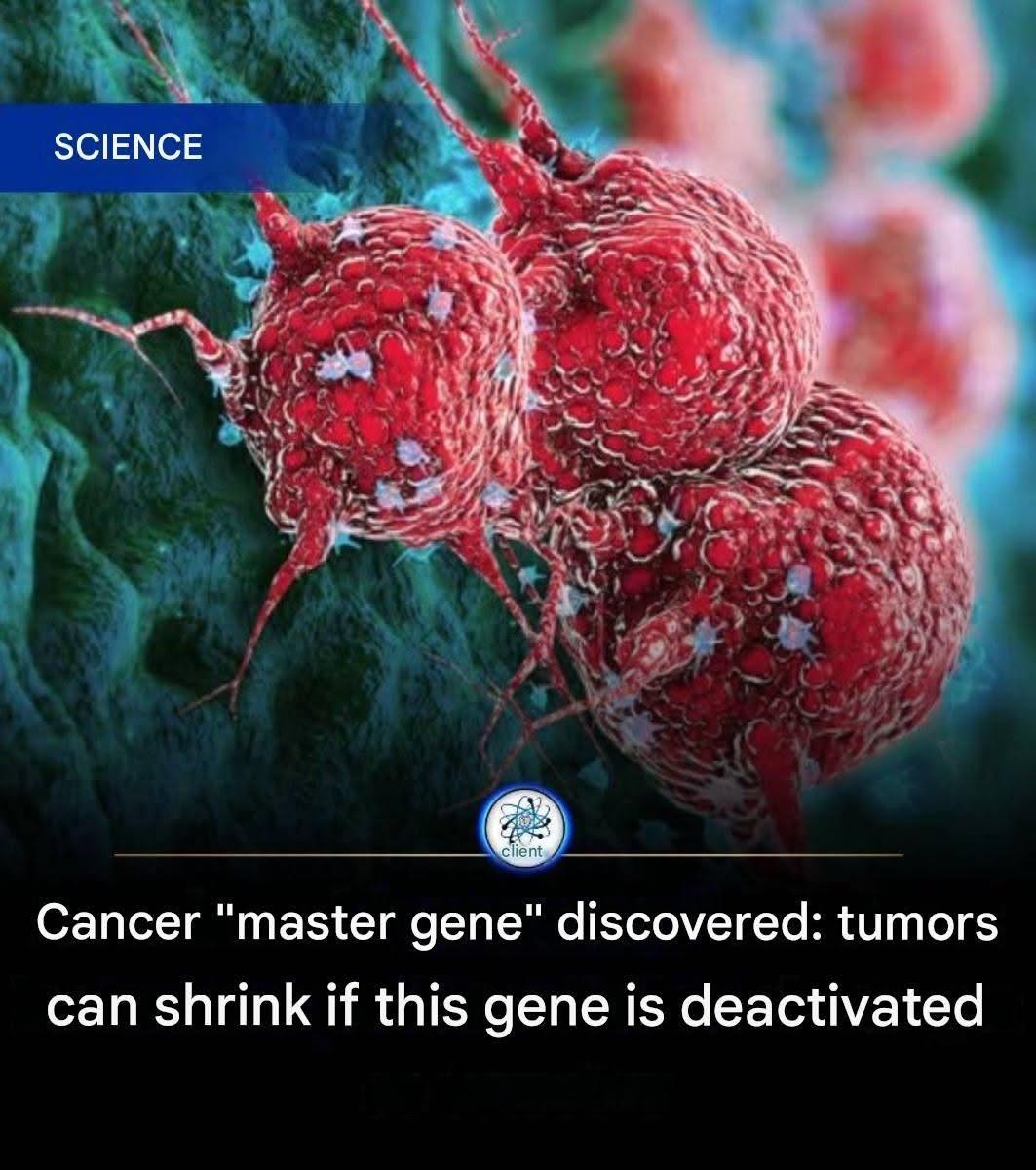
Scientists Identify a Cancer “Master Switch” That Could Help Shrink Tumors When Deactivated
What if some cancer cells have a genetic “switch” that helps them keep growing—and scientists could simply turn that switch off?
It sounds like something from a science-fiction movie.
But researchers are increasingly discovering that cancer cells depend on particular genes and molecular pathways to survive, multiply, and avoid the body’s defenses. When some of these critical drivers are blocked or deactivated in laboratory and animal studies, tumors can sometimes stop growing or even shrink.
The discovery has sparked enormous interest because it could eventually lead to treatments that attack cancer at one of its most fundamental levels: its genetic instructions.
But there is an important detail hidden behind the viral phrase “master gene.”
There isn’t one universal gene that causes every cancer.
Instead, scientists are identifying key genetic drivers—sometimes described as molecular master switches—that certain cancers depend on.
And understanding those switches could change how some cancers are treated.
Cancer Begins With a Cellular Mistake
Our bodies contain trillions of cells.
Normally, cells follow an intricate set of instructions telling them when to grow, divide, repair themselves, and eventually die.
Cancer develops when those controls become disrupted.
Mutations and other changes can cause cells to ignore normal signals. Instead of stopping when they should, cancer cells may continue dividing.
Over time, these abnormal cells can form a tumor.
Some cancer cells can also invade surrounding tissues or travel to other parts of the body.
This makes cancer extremely difficult to treat.
But researchers have discovered something fascinating.
Cancer cells often become dependent on certain genetic pathways to maintain their abnormal behavior.
Scientists call this concept oncogene addiction.
And that dependency could represent a vulnerability.
The “Master Switch” Idea
Imagine a massive electrical system with hundreds of switches.
A cancer cell may have dozens of abnormal processes operating simultaneously—but some of those processes can depend heavily on one central signaling pathway.
If researchers can identify that critical dependency and block it, the cancer cell may lose its ability to survive.
This is where the idea of a “master switch” comes from.
The term is useful for explaining the science, but it shouldn’t be interpreted literally.
Cancer is far too complicated to have one universal on/off switch.
Different cancers—and even different tumors within the same cancer—can have completely different genetic characteristics.
Why Turning Off a Gene Can Matter
Genes provide instructions for making proteins that perform essential functions inside cells.
Some proteins encourage cell growth. Others repair damaged DNA, control cell division, or help cells communicate with one another.
When certain genes become abnormally activated, they can contribute to uncontrolled growth.
Researchers can sometimes interfere with these genes using experimental techniques such as gene editing, RNA-based approaches, or targeted drugs.
When a critical cancer-driving pathway is successfully disrupted, the cancer cell may struggle to continue growing.
In some experimental models, this can result in tumor regression.
That is one reason genetic research has become such an important part of modern oncology.
The Most Exciting Part of the Research
For decades, many cancer treatments focused primarily on killing rapidly dividing cells.
Chemotherapy and radiation can be extremely effective, but they can also damage healthy cells.
Targeted therapies take a different approach.
Instead of attacking every rapidly dividing cell, scientists try to identify specific molecular abnormalities that cancer cells rely upon.
The goal is more precise treatment.
If a tumor contains a particular genetic alteration, doctors may eventually be able to select a treatment designed specifically to exploit that weakness.
This approach is already part of modern cancer care for some cancers.
But There’s a Catch
Here’s where viral headlines can go too far.
A laboratory experiment showing that deactivating a gene causes a tumor to shrink does not automatically mean scientists have discovered a cure for cancer.
There is a long road between a promising laboratory discovery and an approved treatment for patients.
Researchers must determine:
- Whether the finding works in humans.
- Whether the target is present in enough patients.
- Whether healthy cells are affected.
- How the treatment should be delivered.
- Whether cancer cells can develop resistance.
- What side effects might occur.
- Whether the treatment actually improves survival or quality of life.
A discovery can look spectacular under a microscope and still fail during clinical trials.
That’s why scientists move carefully.
Cancer Can Fight Back
One of the biggest challenges in cancer treatment is resistance.
Cancer cells are genetically diverse.
Even inside the same tumor, different groups of cancer cells may carry different mutations.
Imagine researchers successfully blocking one pathway.
Some cancer cells may die.
But another group may already have a mutation that allows it to use an alternative pathway.
Those surviving cells can multiply.
The tumor can then return.
This is one reason researchers are investigating combinations of targeted treatments rather than relying on a single molecular target.
Could This Lead to Personalized Cancer Treatment?
Potentially.
One of the biggest goals of modern oncology is to move away from a “one treatment fits everyone” approach.
Instead, doctors can analyze a patient’s tumor for specific genetic and molecular characteristics.
If a particular mutation or pathway is driving the cancer, a targeted therapy may be considered when an appropriate treatment exists.
This is often called precision medicine.
The more scientists understand cancer’s genetic machinery, the more opportunities they may have to identify vulnerabilities.
And that could eventually allow treatments to become more individualized.
Why Researchers Are So Interested in Genetic Switches
Cancer isn’t simply a collection of cells growing out of control.
It is an evolving biological system.
Cancer cells adapt.
They communicate.
They change their metabolism.
They interact with surrounding tissues.
They can evade immune responses.
And they can sometimes develop resistance to treatment.
Finding a critical genetic dependency gives researchers something extremely valuable:
a potential point of attack.
If that dependency can be blocked without causing unacceptable harm to healthy tissue, it could become a powerful therapeutic target.
Does This Mean a Universal Cancer Cure Is Coming?
Not yet.
And anyone claiming that one newly discovered gene will cure all cancer should be viewed skeptically.
There are hundreds of different cancer types and subtypes.
Breast cancer is not the same disease as leukemia.
Lung cancer is not the same as pancreatic cancer.
Even two patients with the same type of cancer may have tumors with very different genetic profiles.
The future of cancer treatment is therefore likely to involve many different discoveries rather than one miracle gene.
A New Way of Thinking About Cancer
Perhaps the most important development isn’t the discovery of one particular gene.
It’s the growing understanding that cancer cells have weaknesses.
For years, scientists have studied the genetic instructions that allow tumors to grow.
Now they’re increasingly asking a different question:
What does a cancer cell absolutely need to survive?
If researchers can answer that question for individual cancers, they may be able to turn those dependencies against the tumor itself.
That is the promise behind the “master switch” idea.
The Road Ahead
The journey from genetic discovery to cancer treatment is long.
Scientists must test potential therapies repeatedly, first in laboratory models and then through carefully designed clinical trials.
Some discoveries will fail.
Others will lead to incremental improvements.
And occasionally, a breakthrough may fundamentally change how a particular cancer is treated.
That’s why these findings matter—but also why they should be interpreted carefully.
The goal isn’t simply to find a gene that can be switched off.
The real challenge is finding a way to disable cancer’s critical machinery while protecting the healthy cells surrounding it.
And if researchers can continue uncovering those vulnerabilities, the future of cancer treatment could become increasingly precise.
The “master switch” may not be a single gene that controls every cancer. But every new genetic vulnerability brings scientists one step closer to understanding how tumors survive—and how they might ultimately be stopped.
This article is for educational purposes only and does not constitute medical advice. Experimental findings should not be interpreted as an established cancer treatment or cure.