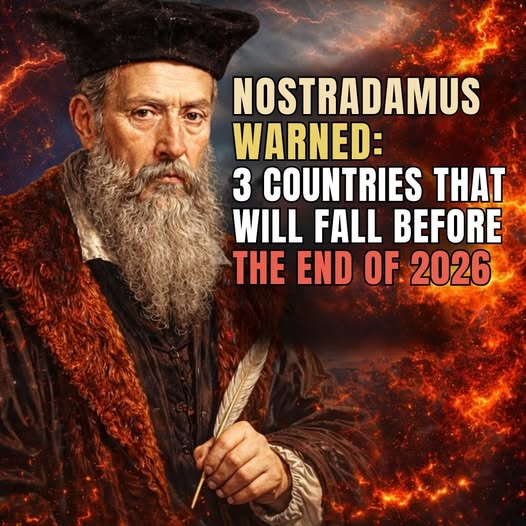
🔮 Nostradamus and His Predictions: Three Interpretations That Some People Connect to the Near Future
For centuries, the name Nostradamus has fascinated people who wonder whether the future can be predicted. His cryptic verses, mysterious imagery, and references to conflict and upheaval have inspired countless interpretations. Even today, readers continue to revisit his writings, searching for clues about what might happen next. 🌍📜
Michel de Nostredame, known as Nostradamus, was a French astrologer and author who published Les Prophéties in 1555. The book contains hundreds of four-line verses, many written in deliberately obscure language.
Some modern commentators believe certain passages could relate to events in the near future. But there is an important distinction: these are interpretations, not verified forecasts. Nostradamus’s verses rarely provide clear dates, names, or details that allow a prediction to be tested reliably.
⚔️ 1. Interpretations About War and International Tensions
One recurring theme in Nostradamus’s writings is conflict between rulers, kingdoms, and powerful groups. Some modern readers interpret these passages as warnings about wars, political rivalries, or tensions between nations.
Because conflict has occurred throughout history, broad descriptions of battles and instability can seem relevant to many different eras.
However, no widely accepted evidence establishes that Nostradamus accurately identified a specific modern conflict in advance. Without precise details, connecting an old verse to a current event can depend heavily on interpretation.
🌪️ 2. Interpretations About Natural Disasters and Climate Events
Other readers focus on passages that appear to describe floods, fires, earthquakes, extreme weather, or destruction.
These descriptions are sometimes linked online to concerns about climate change and increasingly visible natural disasters. The imagery can sound strikingly modern, particularly when a verse is presented alongside dramatic news footage.
Yet natural disasters have been part of human history for thousands of years. A general reference to fire, water, or destruction does not establish that a particular event was predicted.
Scientific observations and modern forecasting methods—not interpretations of centuries-old poetry—are the appropriate tools for assessing natural hazards.
👑 3. Interpretations About Political Change and Powerful Leaders
Nostradamus also wrote about rulers, authority, social upheaval, and changes in power. Some enthusiasts interpret these passages as references to modern political leaders, future leadership changes, or shifts in the global balance of power.
The appeal is understandable: periods of uncertainty encourage people to look for patterns and possible explanations in historical texts.
Still, the verses generally lack the specific, independently verifiable information needed to demonstrate that they identify a particular contemporary leader or future political event.
🧩 Why Do His Predictions Continue to Attract Attention?
Several features help explain Nostradamus’s enduring popularity:
- Ambiguous language: His verses can support multiple interpretations.
- Historical distance: Readers can connect old descriptions to events that were unknown when the text was written.
- Selective matching: Interpretations that seem to fit an event often receive more attention than those that do not.
- Human curiosity: In uncertain times, people naturally search for meaning and reassurance about what lies ahead.
These factors do not mean that every interpretation is made in bad faith. They do mean that a compelling resemblance is not the same as proof of a successful prediction.
🔍 What Should We Believe About the Near Future?
Nostradamus remains an intriguing figure in the history of prophecy and popular culture. His writings offer a window into the fears, beliefs, and imagination of the sixteenth century, while modern interpretations reveal what concerns people today.
But there is no reliable basis for treating these three themes as confirmed predictions of specific future events.
Rather than viewing his verses as a dependable roadmap to tomorrow, readers can explore them as historical literature while relying on evidence, expert analysis, and credible reporting to understand current events.
✨ Final thought: The mystery of Nostradamus lies not only in what he wrote, but also in how later generations interpret his words. The future remains uncertain—and extraordinary claims about it deserve careful examination.
Editorial note: This article discusses popular interpretations of Nostradamus’s writings. It does not claim that any specific future event has been predicted or confirmed.
Create a mysterious historical infographic about Nostradamus and the three themes people associate with his prophecies.