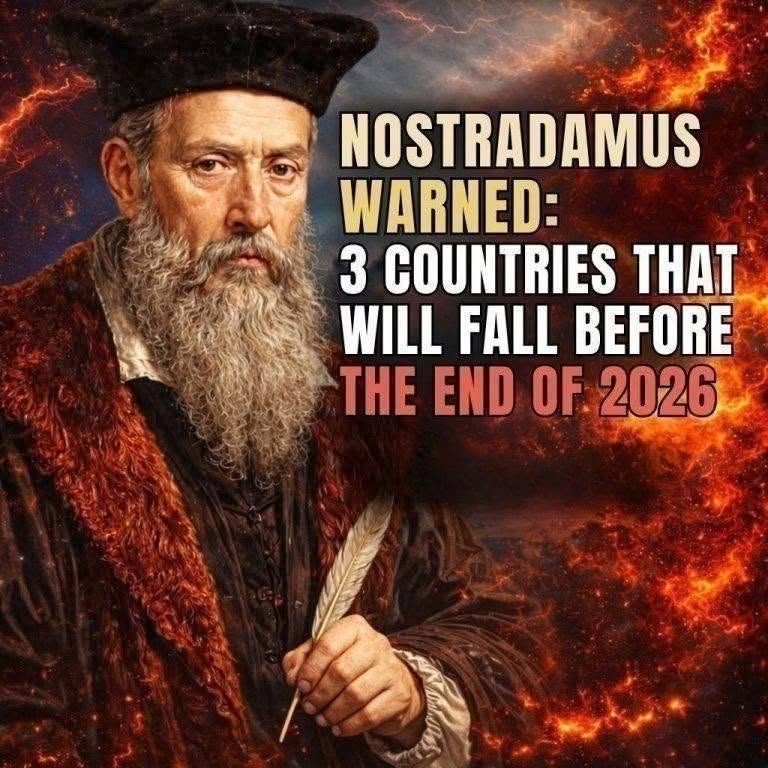
Nostradamus and His Predictions: Three Interpretations Some People Connect to the Near Future
For centuries, the name Nostradamus has been surrounded by mystery.
Michel de Nostredame, better known as Nostradamus, was a 16th-century French astrologer and writer whose collection Les Prophéties became famous for its cryptic verses. Even today, readers continue to search his writings for clues about wars, disasters, political upheaval, and major changes that could shape the future.
But there is an important catch: Nostradamus did not provide clear, dated predictions of modern events. His verses are highly symbolic and ambiguous, which means people can interpret them in many different ways—especially after an event has already happened.
Still, three broad interpretations frequently appear in discussions about the years ahead.
1. A period of political upheaval
Some interpreters connect Nostradamus’s writings about rulers, conflict, and instability to a possible period of political change.
These interpretations are often applied to modern tensions between countries, elections, leadership changes, and international disputes.
However, the verses don’t identify today’s countries or politicians in a way that allows a specific prediction to be verified.
The connection is therefore an interpretation—not a confirmed forecast.
2. Natural disasters and environmental disruption
Another popular interpretation focuses on passages describing unusual weather, floods, fires, earthquakes, and other disasters.
Because extreme weather and natural disasters are already major global concerns, some readers believe Nostradamus was describing events that could occur in the near future.
But these verses are broad enough that they can be connected to many different historical events.
That makes them fascinating to read, but difficult to use as a reliable forecasting system.
3. Major technological or social transformation
Some modern interpretations go even further, suggesting that Nostradamus’s references to strange inventions, changes in society, or unprecedented events could correspond to rapid technological development.
Artificial intelligence, automation, biotechnology, space exploration, and other emerging technologies have led some people to revisit old prophetic texts looking for parallels.
Again, however, the connection comes from modern interpretation rather than a clear statement by Nostradamus about a specific technology.
Why do his predictions seem so accurate?
This is perhaps the most interesting part of the story.
Nostradamus wrote in extremely cryptic language. His verses frequently use metaphors, historical references, unusual names, and vague descriptions.
That allows readers to interpret the same passage in different ways.
After a major event occurs, it’s relatively easy to look backward and find a phrase that appears to describe it.
This is sometimes called retrospective interpretation.
For example, a vague reference to conflict could potentially be connected to dozens of wars. Once someone chooses one particular event, the similarities can suddenly seem remarkable.
Did Nostradamus really predict the future?
There’s no reliable scientific evidence that Nostradamus could predict future events.
His writings are historically interesting and culturally influential, but they shouldn’t be treated as a dependable way of forecasting what will happen next.
That doesn’t make the prophecies uninteresting.
Quite the opposite.
Their mystery has kept people debating them for hundreds of years.
The fascinating question isn’t always “Will it happen?”
Perhaps the better question is:
Why do people continue to see themselves and their future in centuries-old words?
Every generation faces uncertainty.
Wars, economic crises, natural disasters, political changes, and technological revolutions can make the future feel unpredictable.
Nostradamus’s writings provide a mysterious canvas onto which those fears and hopes can be projected.
So if you encounter a headline claiming that Nostradamus has definitely predicted a specific event in the near future, treat it cautiously.
The prophecy may be intriguing—but the interpretation is not the same thing as proof.