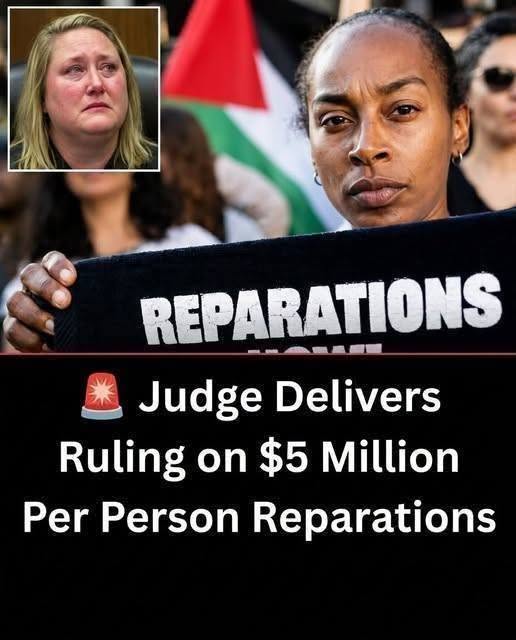
Judge Delivers Ruling on $5 Million Reparations Fund — But the Story Is More Complicated Than the Headline
A judge has delivered an important ruling involving San Francisco’s controversial reparations proposal, a case that has attracted national attention because of a recommendation that eligible Black residents could potentially receive payments of up to $5 million.
But despite the dramatic headlines circulating online, the ruling does not mean that $5 million payments have been ordered or approved.
Instead, San Francisco Superior Court Judge Joseph Quinn ruled that a lawsuit challenging the city’s reparations ordinance was premature. The decision was procedural, meaning the court did not ultimately decide whether a future race-conscious reparations program would be constitutional.
What Was the $5 Million Proposal?
San Francisco’s Board of Supervisors approved a framework for a reparations program, and Mayor Daniel Lurie signed the ordinance in December 2025.
Among the recommendations that attracted the most attention was the possibility of providing as much as $5 million to eligible Black residents.
However, the $5 million figure has often been misunderstood.
The ordinance established a legal framework for a potential reparations program. It did not automatically give every eligible resident $5 million, nor did it allocate the city budget to make those payments.
Any taxpayer-funded payments would require additional action, including identifying a funding source and obtaining the necessary governmental approvals.
Why Did the Lawsuit Begin?
The Pacific Legal Foundation, along with San Francisco residents and the Californians for Equal Rights Foundation, challenged the ordinance.
Their argument was that a government program distributing benefits on the basis of race could violate constitutional protections.
The plaintiffs wanted the court to intervene before taxpayer money could potentially be used for such a program.
But Judge Quinn concluded that the challenge was not yet ready for a definitive ruling.
In essence, the court was being asked to determine whether a program was unlawful before the specific program and payments had actually been implemented.
What Did the Judge Actually Decide?
Judge Quinn sustained the city’s demurrer, which means he found that the plaintiffs’ complaint did not currently establish a sufficient legal claim to move forward in its existing form.
Importantly, however, he allowed the plaintiffs to amend their complaint.
That means the dispute isn’t necessarily finished.
The plaintiffs can attempt to provide additional facts or pursue other legal avenues, including a possible appeal.
The $5 Million Question Remains Unanswered
This is perhaps the most important part of the story.
The judge did not rule that San Francisco must distribute $5 million payments.
He also did not issue a final ruling declaring that such payments would definitely be constitutional.
Instead, the decision leaves the central constitutional question open.
If San Francisco eventually establishes a specific program and commits public money to it, another legal challenge could focus on the exact eligibility requirements, funding mechanism and structure of the payments.
Why the Decision Matters
The case has become part of a much larger national debate about reparations.
Supporters argue that government policies involving housing discrimination, segregation, exclusion and other historic injustices created long-term economic consequences that deserve to be addressed.
Opponents argue that race-based government benefits can themselves violate constitutional guarantees of equal treatment.
The San Francisco case therefore raises questions that extend far beyond one city.
How should historical injustice be addressed?
Who should qualify for reparations?
Who should pay for them?
And can a government program legally distribute benefits according to race or ancestry?
Those questions remain unresolved.
What Happens Next?
For now, the legal fight can continue.
The Pacific Legal Foundation has indicated that it remains prepared to pursue the challenge, while San Francisco’s reparations framework remains a subject of intense political and legal debate.
So if you see a headline claiming that a judge has simply “approved” or “blocked” the $5 million reparations fund, be careful.
The actual ruling was narrower.
It was primarily a decision about whether the lawsuit was legally ready to proceed—not a final determination on whether $5 million reparations payments are lawful.
And that distinction could become extremely important if San Francisco moves toward an actual funded program.
The debate is far from over.