Here’s a full, reader-friendly article you can use for a health blog or Facebook page:
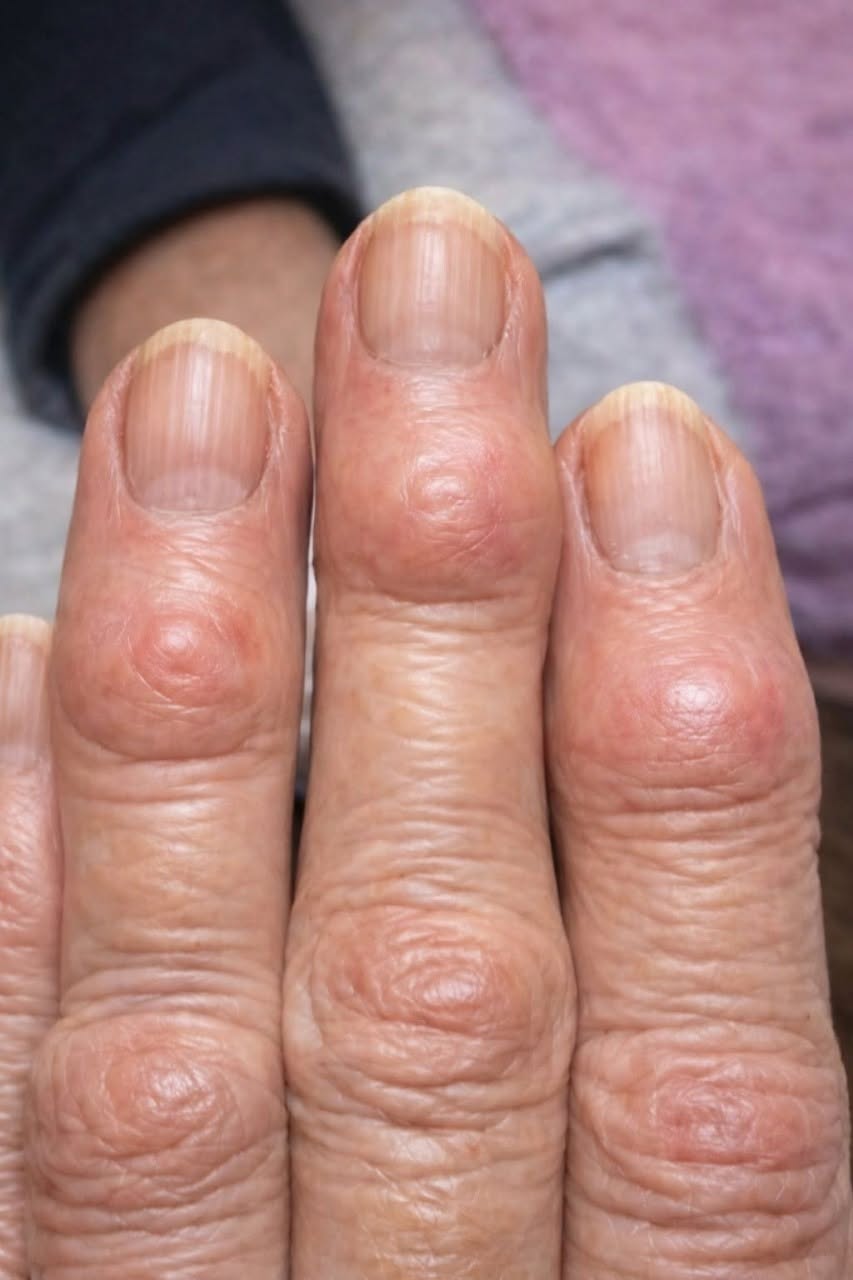
Hard Bumps on the Finger Joints Near the Nails: Why Are They Spreading?
If you’ve noticed hard, knobby bumps developing around the finger joints closest to the nails—especially in an older adult—you may wonder why they seem to be appearing on more and more fingers.
One common reason is osteoarthritis of the finger joints, which can cause firm bony enlargements known as Heberden’s nodes. They often develop gradually and may affect several fingers, sometimes on both hands.
But arthritis isn’t the only possible explanation. The appearance of the bumps, whether they hurt, how quickly they developed, and whether there are changes to the nails can all provide important clues.
What Are These Hard Bumps?
The joints closest to the fingertips are called the distal interphalangeal (DIP) joints. When osteoarthritis affects these joints, the body can produce extra bone around the edges of the joint.
These bony growths can create firm lumps that are sometimes called Heberden’s nodes.
They may initially become painful, swollen, or tender. Over time, however, they can become quite hard and may remain even when the pain settles down.
Why Do the Bumps Seem to Be Spreading?
Osteoarthritis can affect several joints rather than just one.
As cartilage gradually wears down in susceptible joints, changes can develop in multiple fingers. This can make it seem as though the condition is “spreading.”
However, the bumps themselves aren’t contagious and aren’t literally traveling from one finger to another.
Age is an important risk factor, and genetics can also play a role. Some people are simply more likely to develop osteoarthritis-related changes in their finger joints.
Previous injuries or repeated stress on the hands may also contribute.
Could It Be Something Other Than Arthritis?
Yes. Several conditions can produce lumps around the finger joints.
A digital mucous cyst, for example, is a small fluid-filled lump that commonly appears near the last finger joint and may occur close to the nail. These cysts can sometimes be associated with underlying osteoarthritis.
Other possibilities include:
- Gout, which can cause firm deposits around joints
- Rheumatoid or other inflammatory arthritis
- Previous joint injuries
- Ganglion or other cysts
- Skin or nail disorders
- Infection, particularly when there is redness, warmth, drainage, or significant tenderness
Because these conditions can look different from one another, an examination is often needed to determine the cause.
Signs That Often Point Toward Osteoarthritis
Finger osteoarthritis becomes more likely when the bumps are:
- Very hard rather than soft
- Located directly around the finger joints
- Developing gradually
- Present on several fingers
- Associated with stiffness or aching
- More noticeable with age
- Accompanied by changes in the shape or movement of the affected joint
The bumps may also become more prominent over time.
When Should She See a Doctor?
New or progressively increasing lumps should be evaluated, particularly if the diagnosis isn’t already known.
A doctor may examine the hands and, if necessary, order an X-ray or other tests. An X-ray can help identify characteristic changes caused by osteoarthritis.
Medical evaluation is especially important if the bumps are accompanied by:
- Severe or rapidly increasing pain
- Significant swelling
- Redness or warmth
- Pus or drainage
- Fever
- Sudden onset
- Major difficulty moving the finger
- Numbness or weakness
- A rapidly growing lump
- Significant changes around the nail
These features can suggest a problem that isn’t simply ordinary osteoarthritis.
Can the Bumps Be Removed?
If the bumps are caused by osteoarthritis, there isn’t a simple home treatment that makes the underlying bony enlargement disappear.
Treatment usually focuses on controlling pain, maintaining joint movement, and protecting hand function.
Depending on the person’s symptoms, a healthcare professional may recommend measures such as appropriate pain relief, exercises, activity modification, hand therapy, or other treatments.
Surgery is sometimes considered for specific severe problems, but it isn’t necessary for most people with uncomplicated finger osteoarthritis.
What Can Be Done at Home?
If a healthcare professional has determined that the bumps are related to arthritis, gentle hand exercises may help maintain mobility.
Warmth can also feel soothing for some people when the joints are stiff. Avoid repeatedly forcing or “cracking” painful joints, and protect the hands from activities that consistently trigger significant discomfort.
It’s also important not to puncture, squeeze, cut, or attempt to drain a bump at home. A cyst or swollen joint can be mistaken for something else, and opening it can introduce an infection.
The Bottom Line
Hard bumps around the finger joints near the nails are commonly associated with osteoarthritis, particularly in older adults. When several fingers become affected, it may look as though the condition is spreading, but osteoarthritis isn’t contagious—the underlying joint changes can simply occur in multiple joints over time.
Still, not every finger lump is arthritis. Cysts, gout, inflammatory arthritis, previous injuries, and other conditions can cause similar-looking changes.
If your grandmother’s bumps are new, changing, painful, or appearing on multiple fingers, having a healthcare professional examine them is the safest way to identify the cause and determine whether treatment is needed.
This article is for general information and isn’t a diagnosis. A healthcare professional should evaluate new or changing lumps, especially when symptoms are severe or unusual.
If you want, I can also turn this into a more viral Facebook-style health article with a stronger headline and hook.