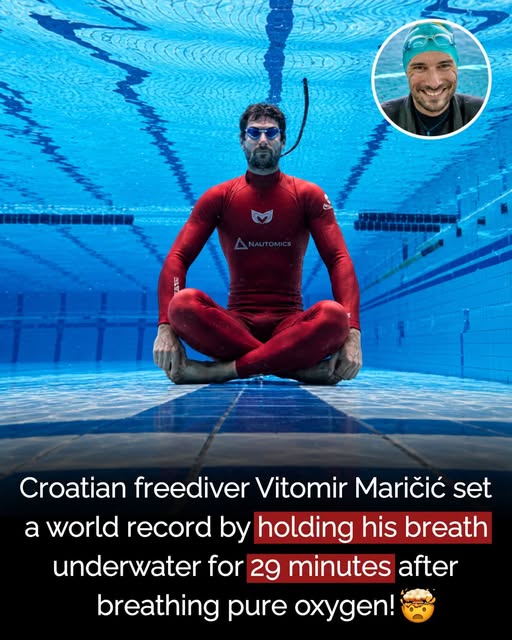
🌊🏆 29 Minutes and 3 Seconds Underwater! Croatian Freediver Makes History
Imagine staying underwater for nearly half an hour without taking another breath. It sounds almost impossible, yet Croatian freediver Vitomir Maričić achieved an extraordinary feat that captured worldwide attention. 🫁🌍
On June 14, 2025, Maričić reportedly held his breath for an incredible 29 minutes and 3 seconds, setting a new Guinness World Record for breath-holding underwater with prior oxygen breathing.
His achievement demonstrated the remarkable combination of preparation, discipline, and physiological control required for elite breath-holding.
🌊 A Record-Breaking Moment in Croatia
The historic attempt took place in a swimming pool in Opatija, Croatia. Before entering the water, Maričić breathed pure oxygen for approximately 10 minutes.
This preparation is an important detail: his record was an oxygen-assisted static apnea attempt, not an ordinary breath-hold performed after breathing normal air.
Breathing pure oxygen before a prolonged breath-hold increases the body’s available oxygen stores, allowing a trained athlete to remain underwater considerably longer than would ordinarily be possible.
🏆 Breaking the Previous World Record
Maričić surpassed the previous Guinness World Record of 24 minutes and 37 seconds, attributed to fellow Croatian freediver Budimir Šobat.
<box gap={1}> <row align=”center” gap={3}> <box flex=”1″ gap={1}> <text color=”secondary” size=”sm”>Previous record — Budimir Šobat</text> <title size=”lg” color=”default”>24:37</title> </box> <box flex=”1″ gap={1}> <text color=”secondary” size=”sm”>Maričić’s record</text> <title size=”lg” color=”default”>29:03</title> </box> </row> <box background=”surface-secondary” radius=”lg” padding={3} gap={1}> <text color=”secondary” size=”sm”>Difference between the two times</text> <title size=”xl”>4 minutes 26 seconds</title> </box> </box>
That difference represents a remarkable improvement in a discipline where preparation, technique, and carefully controlled conditions are essential.
🧠 The Science Behind Long Breath-Holding
The human body has several mechanisms that help it respond to submersion and temporary breath-holding. Trained freedivers learn to remain calm and manage the urge to breathe, while physiological responses can help conserve oxygen.
However, the brain and heart still require a continuous supply of oxygen. Breath-holding for extreme periods carries serious risks, including loss of consciousness, brain injury, and drowning.
This is not something to imitate. Never attempt prolonged underwater breath-holding or oxygen-assisted breath-holding alone, and don’t hyperventilate before swimming. Even experienced athletes require appropriate safety precautions and trained supervision.
🌍 A Reminder of Our Connection to the Oceans
Maričić’s achievement also drew attention to the extraordinary relationship between humans and the aquatic environment. Stories about freediving can inspire appreciation for the oceans, the marine life they support, and the importance of protecting these ecosystems.
Healthy oceans are vital to biodiversity, climate regulation, and communities around the world. 🌎🐠
❤️ Final Thoughts
Vitomir Maričić’s reported 29-minute, 3-second breath-hold is an extraordinary example of what specialized training and preparation can achieve under controlled conditions.
The key distinction is that this was an oxygen-assisted record—not a demonstration of how long an ordinary person can safely hold their breath.
His accomplishment is remarkable, but the most important lesson is to respect the limits of the human body and never risk your life trying to reproduce an extreme sporting record. 🌊🏆
Editorial note: The record category and exact result should be checked against the official Guinness World Records entry before publication.