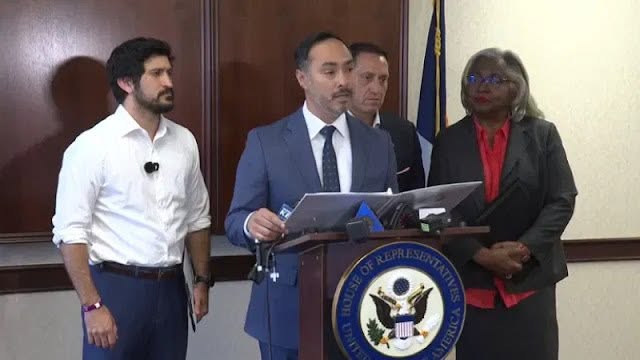
Castro, Casar Warn Bexar County ICE Deals Could Fuel Racial Profiling and Detentions
A new political dispute is unfolding in Bexar County, Texas, where U.S. Reps. Joaquin Castro and Greg Casar are urging several San Antonio-area municipalities to reconsider agreements that allow local law-enforcement agencies to assist federal immigration authorities.
The lawmakers and several local officials argue that these arrangements could increase the risk of racial profiling, civil-rights violations and unnecessary immigration detentions. (Express News)
What is the 287(g) program?
The controversy centers on 287(g), a federal program that allows specially trained local and state law-enforcement officers to perform certain immigration-enforcement duties under agreements with U.S. Immigration and Customs Enforcement (ICE).
According to reporting published Wednesday, six San Antonio-area cities—Hollywood Park, Balcones Heights, China Grove, Saint Hedwig, Sandy Oaks and Von Ormy—have police departments participating in the program. The Bexar County Sheriff’s Office and Bexar County Constable Precinct 3 also participate, under different arrangements. (Express News)
Why are Castro and Casar concerned?
The lawmakers argue that the Task Force Model could allow immigration enforcement to become intertwined with routine police activity, including traffic stops and DWI checkpoints.
They contend that this could undermine trust between immigrant communities and local police and create opportunities for people to be questioned or detained because of perceived immigration status rather than because of evidence of a crime. (Express News)
The officials are also asking participating communities for greater transparency regarding which officers are involved, how much the arrangements cost local governments, how reimbursement works and whether any arrest-related expectations are connected to funding.
ICE says the program has a different purpose
Supporters of cooperation between local law enforcement and ICE argue that these agreements can help federal authorities identify and remove people who are unlawfully present or who have serious criminal records.
The debate therefore isn’t simply about immigration policy.
It is also about where federal immigration enforcement should end and local policing should begin.
A broader ICE controversy in San Antonio
The dispute comes amid another major controversy involving a proposed ICE processing facility on San Antonio’s East Side.
Castro, Casar, Bexar County officials and San Antonio Mayor Gina Ortiz Jones previously opposed the facility and requested greater transparency from the Department of Homeland Security. (Joaquin Castro)
Federal officials have said the planned facility could process hundreds to as many as 1,500 people per day, although the project has faced substantial opposition from local leaders and residents. (Express News)
The bigger question
At the heart of the dispute is a difficult question:
Should local police departments help enforce federal immigration laws, or should their primary responsibility remain local public safety?
Supporters say cooperation can make enforcement more effective.
Critics say it can make immigrant residents afraid to interact with police—even when they are victims or witnesses of crimes.
For now, Castro, Casar and their allies are calling for participating municipalities to reconsider their agreements and provide more information about how the partnerships operate.
Whatever someone’s position on immigration, transparency and clear legal boundaries are essential when local police become involved in federal immigration enforcement.