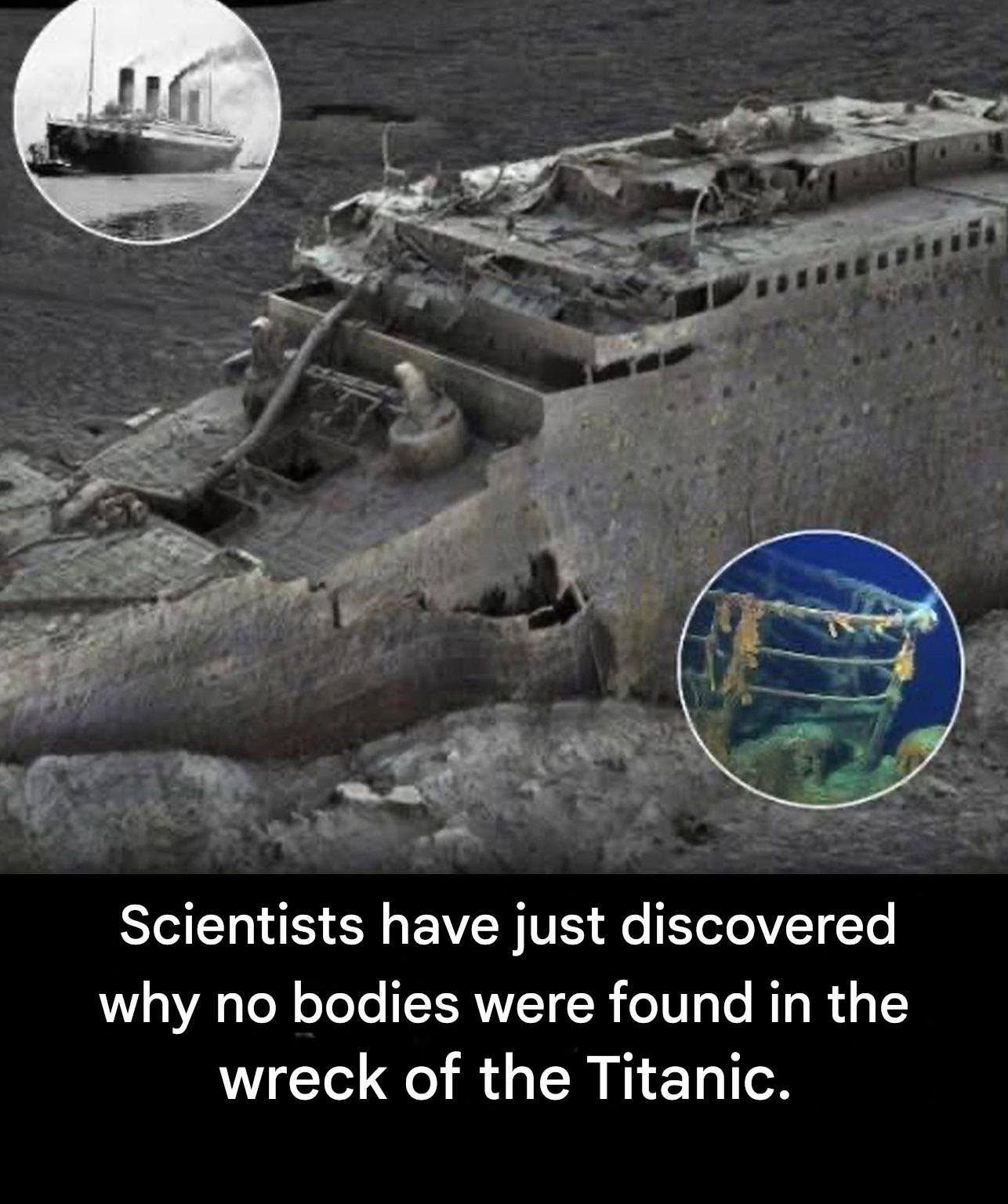
Why Were No Bodies Found in the Wreck of the Titanic?
When the Titanic sank in the North Atlantic on April 15, 1912, more than 1,500 people lost their lives. Yet when the wreck was discovered on the ocean floor in 1985, explorers found very few human remains—and essentially no intact bodies.
So where did everyone go?
🌊 1. The wreck is extremely deep
The Titanic rests roughly 3,800 meters (12,500 feet) beneath the surface. The enormous pressure, darkness, cold, and unusual deep-sea environment have affected everything left at the site for more than a century.
🦴 2. Soft tissue doesn’t survive indefinitely
After death, a body naturally decomposes. In the deep ocean, microorganisms and other organisms can gradually consume organic material. Over decades, this process can leave behind little or no recognizable body.
🐚 3. Deep-sea organisms contributed to decomposition
Scavengers and microorganisms living around the wreck can feed on exposed organic material. Once soft tissue disappears, bones can also be affected by the surrounding environment.
🧪 4. The chemistry of the deep ocean matters
The seawater around the wreck isn’t simply preserving everything like a freezer. Bone can eventually dissolve or deteriorate under certain deep-ocean chemical conditions, particularly when it is exposed rather than protected.
🧳 5. Personal belongings survived much better
This is why expeditions have found shoes, clothing remnants, luggage, bottles, dishes, and other objects scattered around the wreck. Some objects made of materials resistant to decomposition can remain for generations even when human remains do not.
But Were No Human Remains Ever Found?
Not exactly.
Expeditions have documented possible human remains or traces, and investigators have recovered artifacts associated with victims. However, intact bodies are not present throughout the wreck site.
The absence of visible bodies can feel mysterious, but it is largely explained by more than a century of decomposition, deep-ocean biology, and the chemical environment surrounding the wreck.
The Titanic is therefore not a place where thousands of bodies are simply lying preserved on the seabed. Much of what remains today is the ship itself and the personal belongings left behind by those who never made it home.