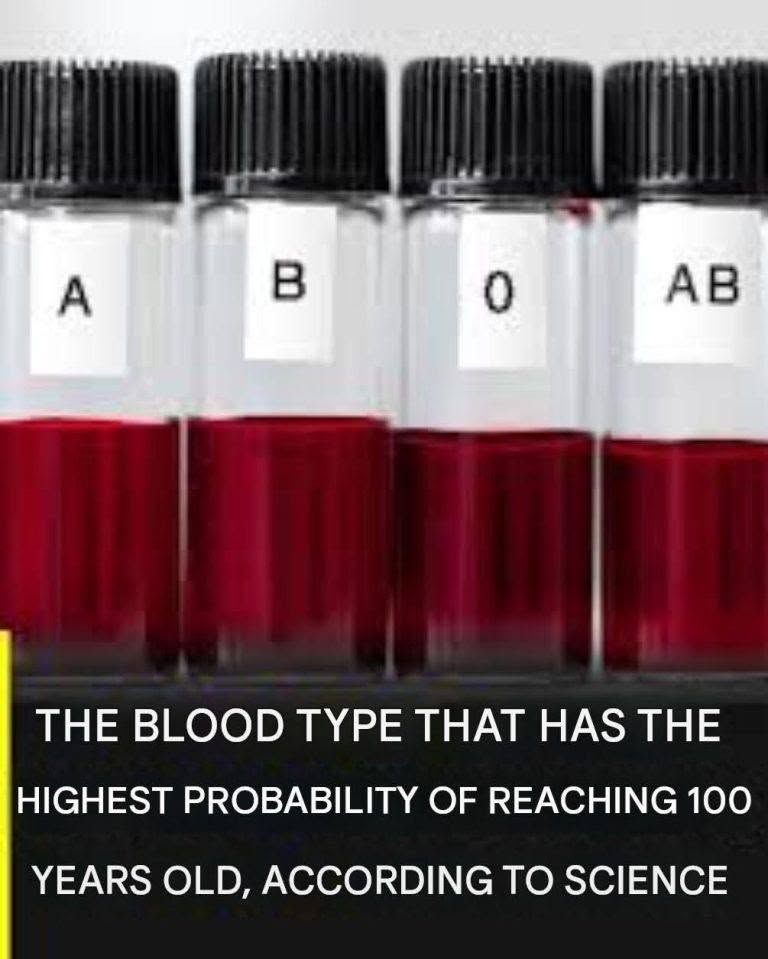
🩸 Is One Blood Type More Likely to Help You Live to 100? What Scientists Really Know
Could something as simple as your blood type have a connection to how long you live?
It sounds almost too strange to be true.
Your ABO blood type is determined by inherited genes, and researchers have spent years investigating whether those genes might also influence susceptibility to diseases that affect lifespan.
But there is an important twist:
Scientists have not found that one blood type guarantees a longer life.
In fact, the research is much more complicated—and that’s what makes it fascinating.
🔬 The blood type that caught researchers’ attention
One Japanese study published in Experimental Gerontology examined 269 people who had reached at least 100 years of age and compared them with more than 7,000 controls.
The researchers found that blood type B appeared somewhat more frequently among the centenarians than among the comparison group. They suggested that type B might be associated with exceptional longevity—but emphasized that the underlying mechanism still needed investigation.
That finding helped fuel headlines suggesting that people with type B blood might be more likely to live to 100.
But there’s a problem with stopping the story there.
⚠️ A much larger study told a different story
Researchers studying 2,201 Chinese centenarians compared ABO blood-group frequencies with those of more than 2,300 middle-aged controls.
They found no statistically significant association between blood type A, B, O, or AB and longevity.
Their analysis, including a meta-analysis of previous studies, also failed to show a significant relationship between ABO blood type and living to an exceptionally old age.
Another study of centenarians in Western Sicily similarly found no significant differences in ABO blood groups between centenarians and comparison groups.
So, is blood type B the secret to reaching 100?
No—not based on the evidence we have today.
🧬 So why are scientists interested in blood type?
Blood type isn’t completely irrelevant to health.
Research has found associations between ABO blood groups and certain cardiovascular, clotting, metabolic, and other diseases. A 2026 review concluded that non-O blood groups generally show higher risks of some thrombotic and cardiovascular events, although the effects are modest and vary between populations.
That could theoretically influence longevity indirectly.
For example, if a particular blood group slightly changes the risk of certain diseases, it might affect health outcomes over a lifetime.
But that is very different from saying:
“This blood type will make you live longer.”
❤️ What actually matters for reaching 100?
Your genes matter—but they are only part of the story.
Lifestyle, environment, socioeconomic factors, access to healthcare, physical activity, nutrition, smoking, alcohol consumption, sleep, social connections, and the prevention or treatment of chronic diseases can all influence health and longevity.
And unlike your blood type, many of these factors can potentially be changed.
The bottom line
Having blood type A, B, AB, or O doesn’t come with a guaranteed expiration date—or a guaranteed path to 100.
There have been intriguing findings, including one study in which type B was more common among Japanese centenarians. But larger research has failed to establish blood type as an independent predictor of exceptional longevity.
So if you know your blood type, it’s interesting information—but don’t let it determine how you think about your future.
Your blood type may be part of your biology. It isn’t your destiny.
And perhaps the more interesting question isn’t “Which blood type lives longest?”
It’s:
“What are the habits and biological factors shared by people who successfully reach 100 in good health?”