The Small Hole on Your Sink Has a Surprisingly Important Function
Have you ever looked at the small hole near the top of your bathroom sink and wondered why it’s there?
It may seem completely unnecessary.
You probably never use it, rarely notice it, and may have assumed it was simply part of the sink’s design.
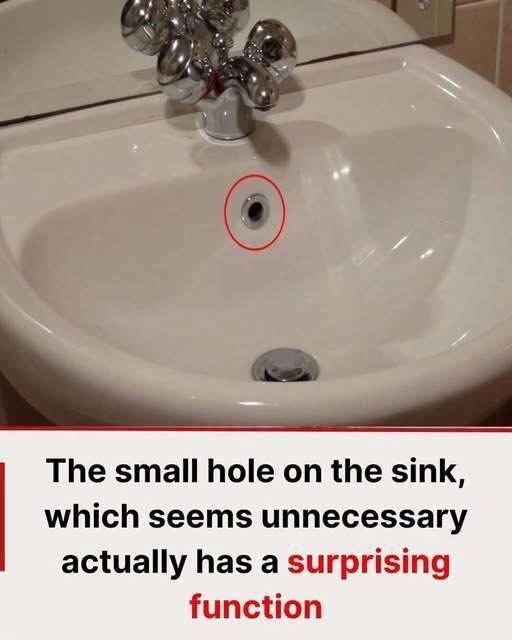
But that little opening actually serves an important purpose: it helps prevent your sink from overflowing.
What Is That Hole Called?
The opening is commonly known as an overflow hole or overflow opening.
You’ll usually find it near the upper inside wall of a bathroom sink, just below the rim.
Its purpose is to provide an additional route for water if the basin begins filling too high.
How Does It Work?
Imagine that you accidentally leave the faucet running while the drain is partially or completely blocked.
Normally, the water level would continue rising.
Eventually, it could spill over the edge of the sink and onto your bathroom counter or floor.
The overflow opening provides another pathway.
Once the water reaches the opening, it can flow through the internal channel and toward the drain system.
That can give you valuable extra time to turn off the faucet before water spills over the rim.
It’s Not a Second Drain
One common misconception is that the little hole is simply another drain.
That’s not quite right.
The opening is part of the sink’s overflow system.
Depending on the sink’s design, the channel behind it connects with the drain area, allowing excess water to escape before it reaches the top edge of the basin.
Why You Should Keep It Clean
Because the overflow channel is hidden inside the sink, it can easily be forgotten.
Over time, soap residue, toothpaste, hair and other debris can accumulate around or inside the opening.
A dirty overflow passage may reduce its ability to move water effectively.
You can periodically clean around the opening with a suitable bathroom cleaner and a small brush.
Avoid forcing sharp objects deep into the passage, since you could damage the sink or plumbing components.
What If Water Comes Out of the Hole?
If you’ve ever seen water disappear into that little opening, that’s normal.
It’s doing exactly what it was designed to do.
However, if water backs up through the opening or drains unusually slowly, you may have a clogged drain or overflow passage.
That’s a good reason to investigate the blockage rather than simply ignoring it.
Why Don’t Kitchen Sinks Always Have One?
This is another interesting detail.
Not every sink is designed with an overflow opening.
Bathroom sinks commonly have them, while many kitchen sinks don’t.
The design depends on the sink’s construction, plumbing arrangement and intended use.
Some sinks instead rely on other drainage or overflow-prevention designs.
A Tiny Feature With a Big Job
It’s easy to overlook small details around the home.
But that little hole in your sink is a good example of how something that appears unnecessary can actually serve an important safety function.
So the next time you wash your hands and notice that small opening near the top of the basin, remember:
It’s not a useless hole. It’s your sink’s built-in backup plan against overflowing water.
And now that you know what it’s for, you might never look at your sink the same way again.