The Hidden Meaning of a Blue Stop Sign: What Does It Really Mean?
Most drivers could recognize a stop sign instantly.
The familiar red octagonal sign with the word STOP is one of the most recognizable traffic symbols in the world.
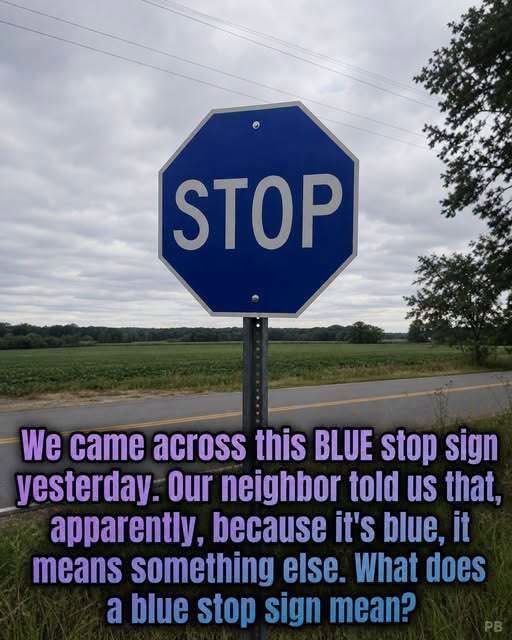
So what happens when you see a blue stop sign?
A photo of one can quickly spark confusion online, with people wondering whether it represents a new traffic law, a special warning, or something completely different.
The answer depends heavily on where the sign is located.
Blue Stop Signs Aren’t Automatically a New Traffic Rule
Unlike the standard red stop sign used on public roads in many countries, a blue octagonal sign is not universally recognized as a replacement for the normal stop sign.
In some locations, blue signs can be used for private roads, parking areas, residential communities, campuses, or other privately controlled spaces.
In other cases, a blue octagonal sign may be decorative or designed for a specific local purpose.
That’s why you shouldn’t assume that every blue octagonal sign has the same legal meaning.
Why Is the Traditional Stop Sign Red?
There’s a reason red became associated with stopping.
Red has long been used to communicate danger, prohibition and the need for immediate attention.
The standardized octagonal shape also helps drivers recognize a stop sign even when the sign is partially obscured or seen from the back.
In the United States, the Manual on Uniform Traffic Control Devices specifies the familiar red-and-white STOP sign for standard traffic control.
So if you’re driving on a normal public roadway and encounter an unfamiliar sign, don’t rely on its color alone.
What About Blue Signs?
Blue is commonly associated with information or services in traffic-sign systems.
For example, blue signs may identify:
- Parking facilities
- Accessible parking
- Hospitals or medical services
- Motorist services
- Other information or facilities
A blue octagonal sign, therefore, doesn’t automatically mean “stop” simply because it has eight sides.
Its meaning depends on the jurisdiction and the circumstances in which it is being used.
Why Are These Signs Going Viral?
Images of unusual road signs often spread online because they challenge what people think they already know.
A blue stop sign looks strange precisely because drivers have been conditioned to recognize red + octagon + STOP as one combination.
But traffic signs aren’t necessarily identical everywhere.
Different countries, municipalities and private property owners may use signs with different designs or purposes.
That means an image without a location can be misleading.
What Should Drivers Do?
If you encounter an unfamiliar traffic sign, the safest approach is simple:
Slow down and follow the applicable traffic controls.
Don’t assume a sign is meaningless just because it doesn’t look familiar.
If you’re unsure about its legal significance, check the local traffic authority’s rules or ask a qualified local source.
And never treat a viral social-media post as a substitute for your area’s official traffic regulations.
The Bottom Line
A blue stop sign may look mysterious, but there isn’t one universal hidden meaning behind every blue octagonal sign.
The location, wording, surrounding markings and local traffic regulations determine what the sign actually means.
So before sharing a post claiming that a blue stop sign has a secret nationwide meaning, check the source—and most importantly, check where the sign is located.
Have you ever seen a blue stop sign in your area?